Select a quadrant of the grid map above to navigate the map. Click on the number for more information.
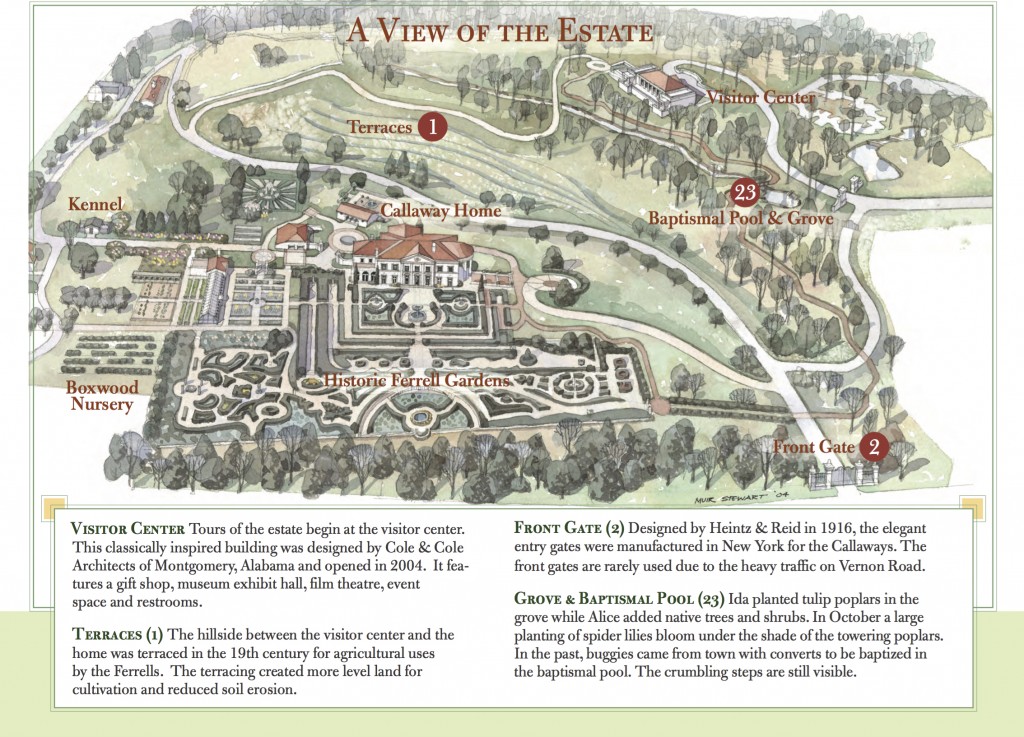
The hillside on the northeast side of the property, below the home, was terraced in the 19th century. Cotton was grown on these terraces when the Ferrell’s owned the property.
Designed by Hentz & Reid in 1916 the elegant entry gates were manufactured in New York for the Callaways.
The Fuller E. Callaway home was designed by Hal Hentz and Neel Reid to complement the formal gardens started by Sarah Ferrell. The commission began in 1914 and was completed in 1916.
Family and guests frequently entered the home from this covered entry which features beautiful cast-stone columns and a vaulted ceiling.
Note the Southern Magnolia espaliered (trained to grow flat against the wall) on the side of the former garage and chauffeur’s quarters, framing the arched windows.
The bathhouse was added by Alice and Fuller Jr. in 1941. It was designed by architect Hill R. Huffman of Atlanta to blend with the existing architecture of the estate. The swimming pool was replaced in 2004 with a terrace that features an attractive central fountain.
In the early to mid-1900’s the Callaway family had a large vegetable garden in this area. In 1950, Alice Callaway converted part of the old vegetable garden into the Ray Garden, where she grew roses, ornamental conifers and colorful annuals.
These sturdy cold frames are seasonally covered with glass to protect tender plants from the winter cold. The garden workhouse is situated over the boiler room which provided heat for both the main house and the glasshouse.
The herb garden contains a wide variety of culinary, medicinal, and aromatic herbs. Four rose pillars with antique climbing roses pay homage to the rose garden that was once here.
Originally constructed in 1916, the greenhouse was remodeled in 1949 by Alice and Fuller Callaway, Jr. and is maintained much the same as it was in Alice’s time.
This is the oldest part of the garden where Sarah Ferrell started her planting in 1841. Once called the Sanctuary, this garden area contains several religious symbols planted in boxwood.
Sarah Ferrell drew her inspiration for this cluster of grapes planted in boxwood from a Biblical account in Numbers.
The Sunken Garden is delineated by a beautiful semi-circular stone wall. Stone steps on each side lead down to a curved stone bench and a round pool.
The Magnolia Walk is the longest terrace in the garden. Magnolias along this terrace were reportedly planted from seed during the War Between the States.
At the east end of Magnolia walk, near the GOD topiary is where Sarah Ferrell’s boxwood maze is said to have been. Fuller, Sr. redesigned this area after purchasing the property, while Alice Callaway added St. Fiacre to the birdbath.
The unique bird gate was commissioned by Alice Callaway from noted blacksmith Ivan Bailey.
At the east end of the Magnolia Walk Sarah Ferrell planted the word “GOD” in boxwood.
This stone wellhead marks the location of another well that was used to water the garden during the Ferrell era. It features ironwork designed by Neel Reid. Beside the well is a hedge of Tea plants shaped in a shallow “v” which was installed by Alice Callaway.
The long narrow walkway bordered on both sides by large boxwood is called Lover’s Lane.
This garden walkway was named Florida Lane since it contained many tender and tropical plants brought back from Florida by the Ferrell’s and Callaway’s.
On the upper terrace adjacent to the home are boxwood mottos planted by Sarah Ferrell and Ida Callaway. The large central fountain was added at the suggestion of Neel Reid in 1916.
On this avenue, the yellow flowering golden rain trees offer shade to the stone benches added by Fuller and Ida Callaway.
Sign-Up for our E-mail Newsletter and get the latest news at Hills & Dales. click here
See what’s happening the coming months at Hills & Dales Estate. find out
Are you interested in visiting Hills & Dales Estate in every season? learn more